How it works
Every week follows the same four calm steps. You open the book; the curriculum does the planning.
- Read or listen Any mix — read aloud, your child reads, or the audiobook. Reading comes first.
- Summarize Your child tells it back their own way — spoken, drawn, or written.
- Meet the science A short, real science idea connected to the story.
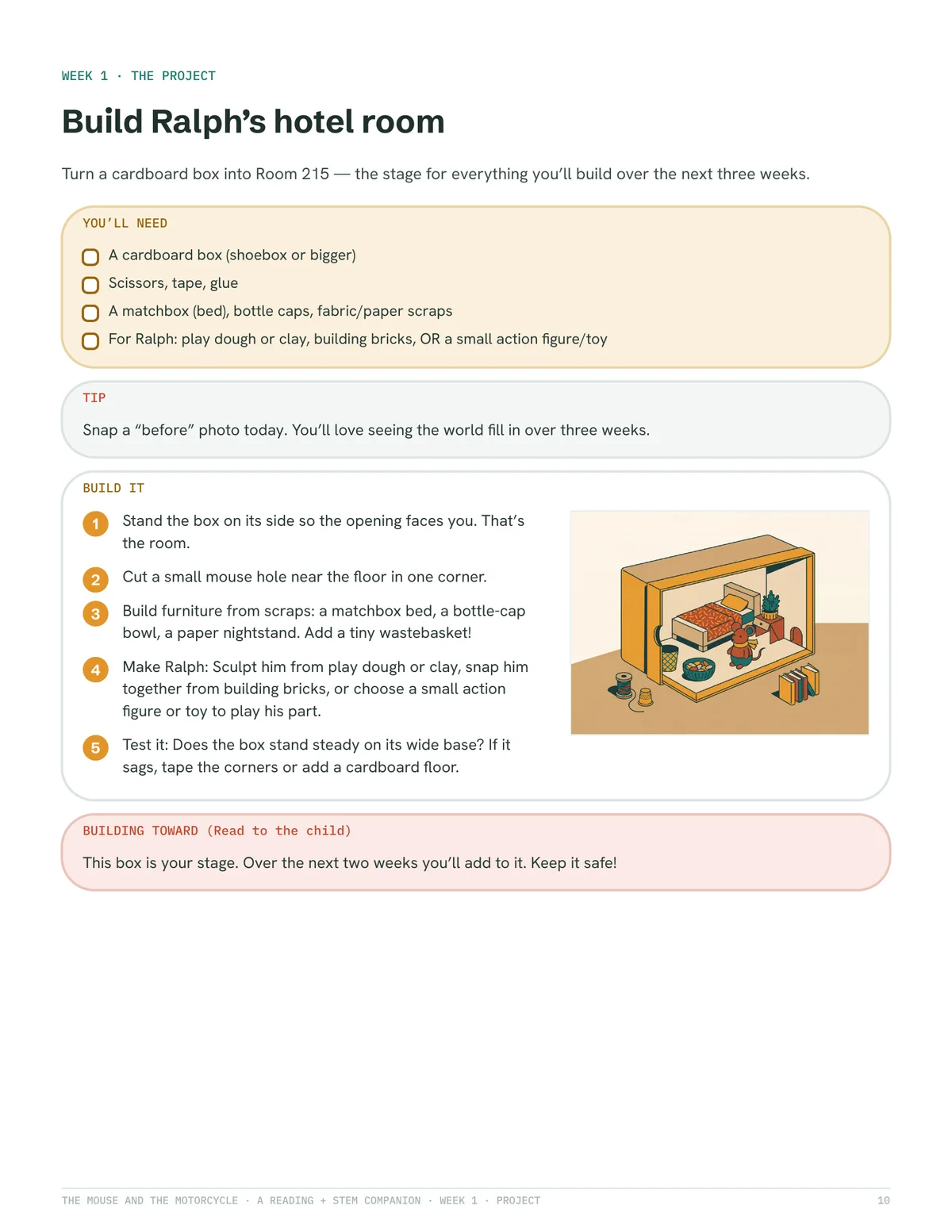
- Build it One hands-on project that turns the idea into something real.
Anatomy of a unit
Each of the twelve books gets three weeks. The projects are cumulative — by the end your child has one finished build and a portfolio full of photos.
Week 1 — set the stage
Read the opening chapters, meet the first science idea, and build the world the story lives in.
Week 2 — build & test
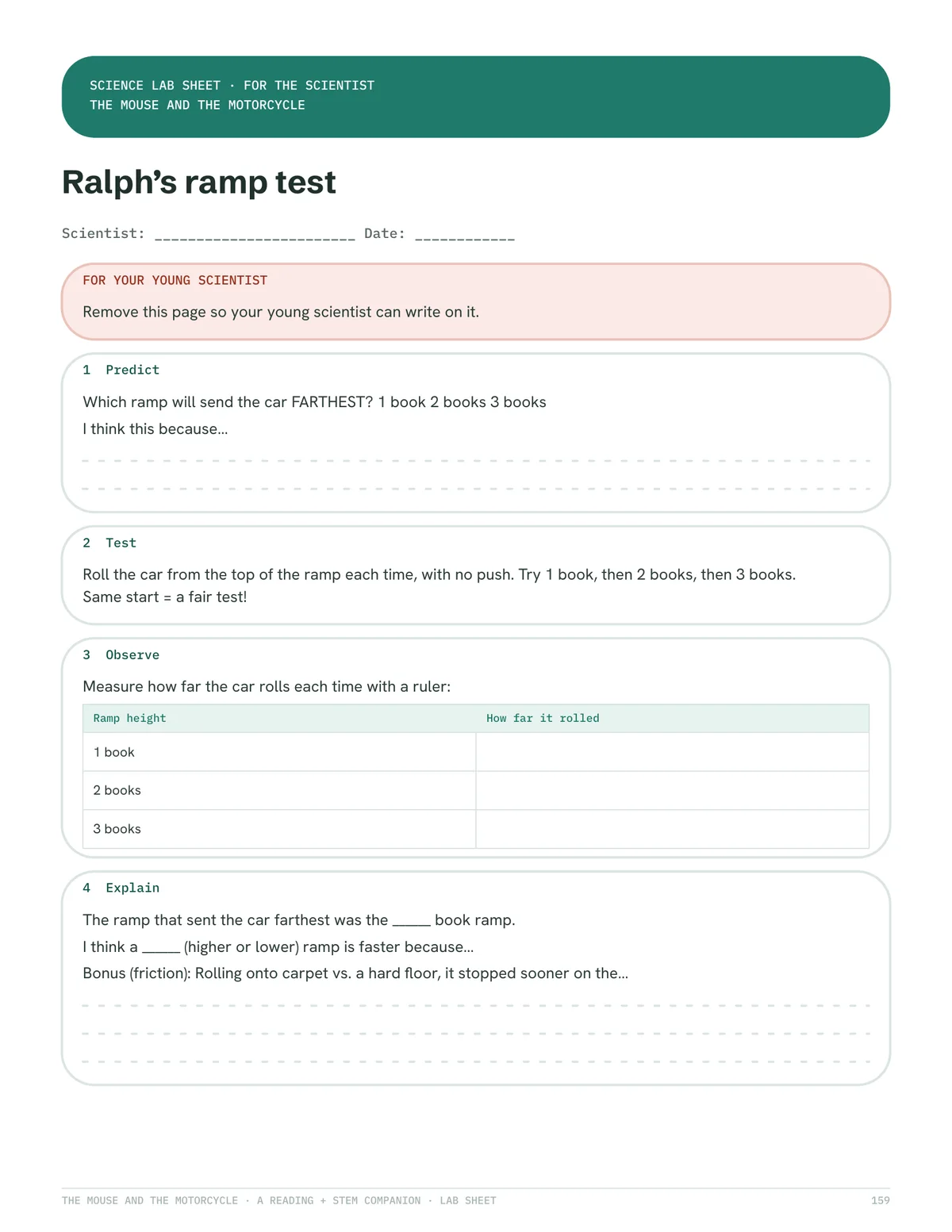
Read on, then run the unit’s real experiment — predict, test, observe, explain — on a kids’ lab sheet.
Week 3 — finish the world
Finish the book and add the final machine or creature. The three builds click into one playable scene.
Predict → test → observe → explain
One week in every unit runs a true experiment on a printable kids’ lab sheet. The science box gives the idea; the build proves it.
Little tools for the in-between days
Reading happens most days; the big project is once a week. Four optional tools keep the days between exciting — use as many or as few as you like.
Game-board
A printable board for the fridge — your child moves a marker one space per finished chapter. Reaching FINISH completes the book.
Secret missions
A question for every chapter, given before reading. They listen for the answer as they read, then check if they were right.
Listening clicker
Each unit names one thing to listen for. Hand your child a bell or shaker and they signal every time they catch it.
Earn-a-piece
Hand over one project material each day your child reads — by build day they’ve collected the kit and can’t wait to see what it becomes.